
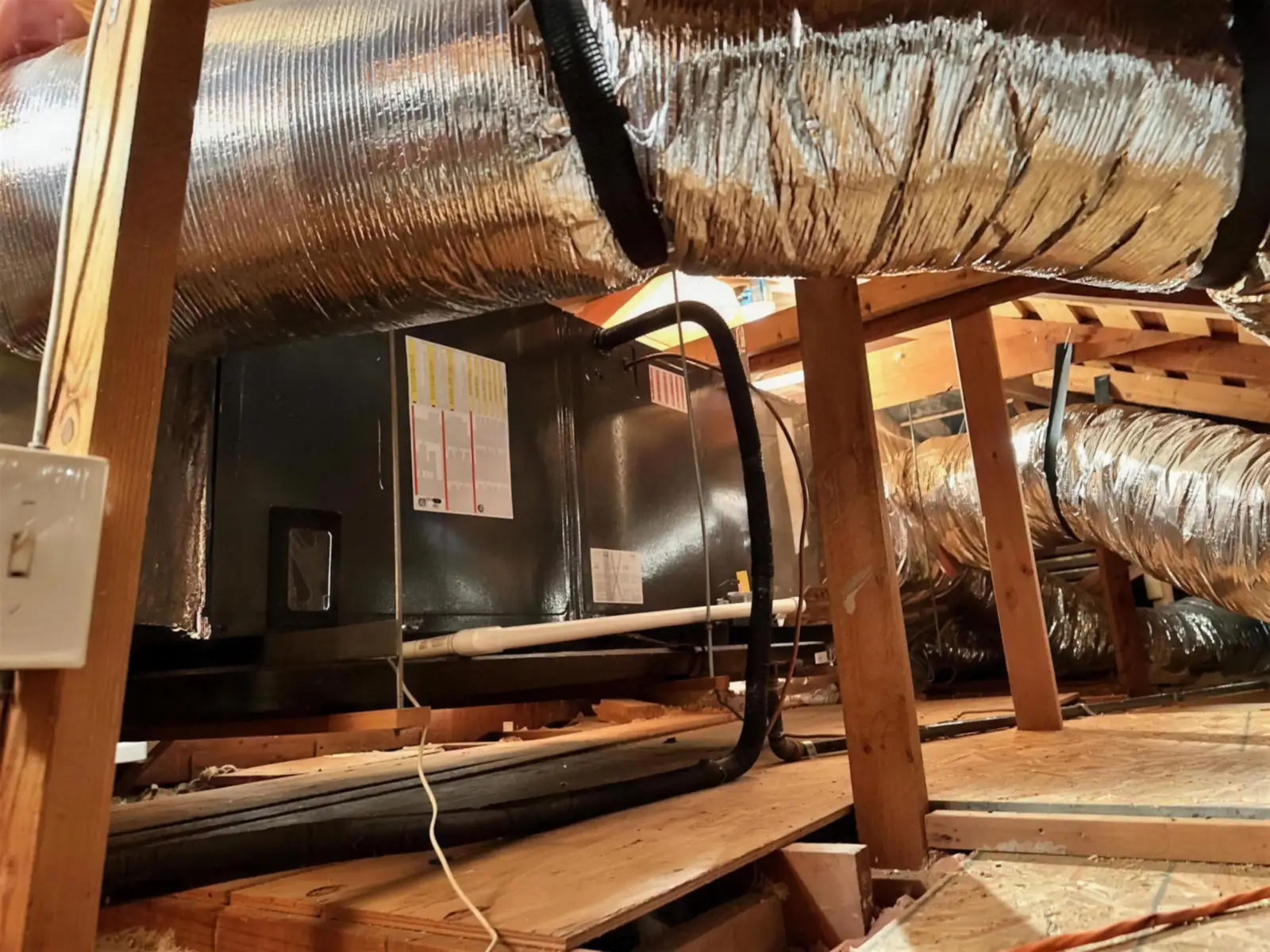
Whole House Fan & Solar Attic Fan Installation in Redding, CA
Apex installs whole house fans and solar attic fans for homes in Redding, CA and the towns nearby. A whole house fan pulls cool evening air in through your windows and pushes the day’s heat out through the attic, so the house is cooled for a few hundred watts instead of a running air conditioner.
A whole house fan in Redding earns its keep on summer nights, when the air outside drops well below the air trapped indoors. We size the fan to the house, check that the attic can breathe out what the fan pushes in, and install it neatly in a hallway ceiling. Call (530) 972-2739 to book a free estimate.
Fan Work We Handle
- Whole house fan installation in hallway or central ceilings
- Sizing the fan to the home’s floor area and the attic’s vent area
- Solar attic fans mounted on the roof to exhaust attic heat
- Replacing old, noisy or leaky louvered whole house fans
- Checking attic vents and adding vent area when the fan needs it
- Insulation thin around the attic hatch and fan? See blown-in attic insulation
Cool Nights, Less AC
Evening air does the cooling, so the air conditioner starts later the next afternoon or not at all.
Heat Out of the Walls
Hours of outside air flushing the house cool the walls, floors and furniture, not just the air.
A Cooler Attic
Both fan types push hot attic air outdoors, so less of it soaks down through the ceiling.
Fresh Air Through the House
Stale indoor air and cooking smells leave through the attic while outdoor air comes in the windows.
Not sure what to budget? See what HVAC costs in Redding.
Request a Free Quote
Send your request from this page: it reaches our office marked Whole House Fans, so we know what it is about before we call you back.
- Phone Number
- (530) 972-2739
- Email Address
- office at apexhvac.co
- Service Area
- Northern CA, Redding, Shasta County & Beyond

How a whole house fan cools a Redding home
A whole house fan sits in the ceiling, usually in a central hallway, and blows up into the attic. With a few windows open, it pulls outdoor air in through them, sweeps it across the rooms and pushes warm indoor air out through the attic vents. The U.S. Department of Energy puts it simply: running the fan whenever it is cooler outside than inside will cool the house (DOE whole house fan fact sheet).
Redding’s summer pattern suits that well. NOAA’s monthly normals for Redding Municipal Airport put the July normal high at 99.9 degrees and the July normal low at 67.0 degrees (NOAA monthly normals), a swing of more than 30 degrees. A house closed up all day stores afternoon heat in its walls, floors and furniture, and a fan running through the night flushes it out. The DOE notes that the cooled materials keep the house comfortable into the next day, so the air conditioner starts later and runs less.
California’s energy code agrees. The Shasta County building division places the valley floor, Redding included, in Title 24 climate zone 11 (Shasta County Department of Resource Management), and the 2019 residential standards put a whole house fan on the prescriptive path for new single-family homes in zones 8 through 14, which the Energy Commission describes as zones where a home can be cooled efficiently on cool summer evenings (CEC 2019 residential compliance manual, chapter 4). Most older homes in town predate that, so adding a fan to an existing house is our common job.
Sizing the fan and the attic vents
A fan that is too small barely stirs the air, and one that is too big for the attic just pressurizes it. For new homes, the Energy Commission’s prescriptive standard calls for at least 1.5 cubic feet per minute of airflow for each square foot of conditioned floor area, which works out to 2,400 CFM for a 1,600 square foot house. We start there, then look at how the rooms connect, since air has to reach the fan from every room you want cooled.
The other half is the attic. Everything the fan pushes up has to leave through the roof, gable and soffit vents, and the DOE and the Energy Commission use the same rule: at least one square foot of net free vent area for every 750 CFM of fan airflow. If the attic falls short, the air backs up and can push dust down through gaps in the ceiling. The DOE also advises sealing openings such as light fixture boxes, plumbing cutouts and a loose hatch. We measure the vents at the estimate and quote added venting or sealing when the fan needs it; our insulation and ventilation team handles that work.
What happens on install day
Most fans go in a hallway ceiling near the middle of the house, where air from every room can reach them. We lay down floor protection, mark the opening between the ceiling joists or trusses, and build a frame so the fan sits on solid support. The DOE’s guidance is never to cut a truss chord, and we do not; the frame spans between them.
Older designs mount a large blade right in the ceiling behind louvers. Many newer models hang the motor in the attic on a flexible duct, which keeps them much quieter, and close the opening with insulated doors when off. We go over the options at the estimate.
We connect the fan’s wall control, clear the insulation back so it meets the fan box properly, and run the fan with you before we leave. If the insulation around the fan and across the rest of the attic floor is thin, our blown-in insulation service can top it up in the same visit.
Running a whole house fan the right way
Open the windows first. The DOE says to open at least two windows before turning the fan on, especially in the rooms you want cooled. Against closed windows, the fan can pull exhaust down the flue of a gas furnace or other fuel-burning appliance inside the house, which the DOE calls backdrafting. We check for those appliances at the estimate.
Run it when the outdoor air is cooler than the indoor air, usually evening through early morning, then close up the house before the day heats up. Never run it with the air conditioner on. On wildfire smoke days, leave it off, because it pulls in outdoor air with whatever is in it; our wildfire smoke guide covers what to do instead. In winter, the DOE calls a fan with plain louvers essentially a large, uninsulated hole and recommends an insulated cover; fans with insulated doors handle that on their own.
Solar attic fans: what they do and do not do
A solar attic fan is a different tool. It mounts on the roof, runs off its own small solar panel and needs no wiring to your electrical panel. It exhausts hot air from the attic while the sun is up, lowering the heat that builds above your ceiling. It does not move air through the living space, so it does not cool the rooms the way a whole house fan does.
An attic fan needs enough intake vent area to feed it. If it pulls harder than the soffit and gable vents can supply, it draws air up from the house through gaps in the ceiling. We check the intake vents first, and tell you plainly if added venting or air sealing would do more than a fan.
What fan installation costs, and where we work
We price each job after the free estimate, because the fan model, the attic framing, the wiring run and any vent area to add all change the work; we do not publish a set price. Financing is available for installations, our labor comes with a 1-year workmanship guarantee, and first responders get 15 percent off. The City of Shasta Lake’s electric utility lists a $500 whole house fan rebate for homes on its power that have central air; details are on our Shasta Lake page. For sourced price ranges on heating and cooling equipment, see the HVAC cost guide.
Our office hours are 7am to 5pm, and we install fans in Redding and across Shasta County into Tehama County. You can read local notes for Anderson, Cottonwood and Red Bluff, and see every town on our service area page. If you would rather cool with refrigerated air, our new HVAC installations page covers central air and heat pumps.
Why Redding Homeowners Call Apex for Whole House Fans
A whole house fan is a hole in your ceiling that moves thousands of cubic feet of air a minute, so where it goes and how the attic handles it matter. Apex is family-run and licensed (CA LIC. #1122085), and we fit the fan to the house, the attic and the cooling system you already have.
Explained Before We Cut
At the estimate we show you where the fan would go, how it works and how you would run it, so nothing about install day is a surprise.
Clean, Careful Installs
We frame the opening without cutting a truss, protect the rooms below, and leave the hallway as clean as we found it.
Whole House Fan Questions
A whole house fan sits in a ceiling inside the house and pulls outdoor air in through open windows, pushing warm indoor air out through the attic. An attic fan, including a solar attic fan, sits on the roof or a gable and only exhausts hot air from the attic. The first cools your rooms; the second cools the attic.
Yes, it suits our summers well. Afternoons are hot, but the normal July low is more than 30 degrees below the normal high, so a fan running through the evening and night can flush the stored heat out of the house. California’s energy code lists a whole house fan on the prescriptive path for new homes in our climate zone for that reason.
For many spring and fall days it can. On the hottest stretches, when nights stay warm, or on smoky days, you will still want air conditioning. Many households use the fan to start each day with a cooler house, so the air conditioner runs less.
It depends on the floor area, the ceiling height and the attic. California’s standard for new homes calls for at least 1.5 cubic feet per minute for each square foot of conditioned floor area, and the attic needs about one square foot of net free vent area for every 750 CFM. We measure both at the free estimate.
Yes. Open at least two windows, more in the rooms you want cooled, before you turn it on. Without open windows the fan strains and can pull exhaust back down the flue of a gas appliance inside the house.
A fan with plain louvers can, because louvers do not seal or insulate. Many newer fans close with insulated doors. For older louvered fans, an insulated winter cover over the opening solves it.
They can lower attic heat on sunny afternoons without adding to your electric bill. They only work well with enough intake vents, and they do not cool the rooms directly. We check your attic and tell you honestly whether a fan, more venting or more insulation is the better spend.
Other services
- New HVAC Installations
- HVAC Repairs
- AC Repair
- Furnace Repair
- Emergency HVAC Repair
- HVAC Maintenance Plans
- Commercial HVAC Services
- Home Air Quality Testing
- Mini Split Installation
- Heat Pump Installation
- Insulation & Ventilation
- Duct Repair & Replacement
- Swamp Cooler Service
- Blown-In Insulation
- Mini Split Repair & Service
- Thermostat Installation
- Thermostat Repair
- Home Sale HVAC Inspection
Our Commitment
Transparent Pricing
Clear, upfront estimates before we start: no hidden fees, no surprise charges once the work is underway.
Guaranteed Work
Trusted parts and materials on every job, backed by our labor guarantee.
Emergencies don’t just happen during business hours. We’re available 24/7.