Pro-Grade Indoor Air Quality Testing in Redding
Apex tests indoor air quality in Redding, CA homes, measuring dust, mold, VOCs, humidity and carbon dioxide levels. Our certified technicians give homeowners clear, data-backed results, so problems that show up as allergies or musty odors have a measured cause.
What We Test & Evaluate
- Particulate matter (PM2.5 / PM10): dust, smoke, pollen, pet dander
- Volatile organic compounds (VOCs) from paints, cleaners, and building materials
- Mold and fungal spores, including hidden moisture issues
- Humidity and moisture levels that risk mold or mildew
- Carbon dioxide levels and ventilation efficiency
- Overall airborne particulate and allergen load
Accurate Diagnostics
Advanced testing reveals actual dust, mold, and VOC levels rather than guesswork.
Personalized Solutions
Custom purification and ventilation recommendations based on what we find in your home.
Healthier Air
Cleaner air reduces allergy symptoms and improves daily comfort.
Energy Efficiency
Fixing airflow and filtration issues also helps your HVAC system run more efficiently.
Not sure what to budget? See what HVAC costs in Redding.
Request a Free Quote
Send your request from this page: it reaches our office marked Home Air Quality Testing, so we know what it is about before we call you back.
- Phone Number
- (530) 972-2739
- Email Address
- office at apexhvac.co
- Service Area
- Northern CA, Redding, Shasta County & Beyond

Why indoor air matters in Redding
Most of us spend the largest share of our day indoors, and in Redding that is even more true in July and August. Redding Municipal Airport sees about 41 days a year at or above 100F, and its July average high is 99.9F, going by NOAA’s 1991 to 2020 averages. Source: NOAA climate normals. Windows stay shut, the air conditioner runs for months, and the same air circulates through your ducts again and again.
Winter is the mirror image. The same NOAA station logs about 27 days a year at or below 32F, so the house gets closed up again, with the furnace or heat pump doing the work. Dust, pet dander, cooking fumes and moisture have nowhere to go in either season unless the system filters them out or fresh air is brought in on purpose.
If you wake up stuffy, notice a musty smell in a closet or find dust settling within a day of cleaning, the air in your home is telling you something. A test turns that feeling into measurements, so you know whether the cause is the filter, the ducts, moisture or something else.
What a testing visit looks like
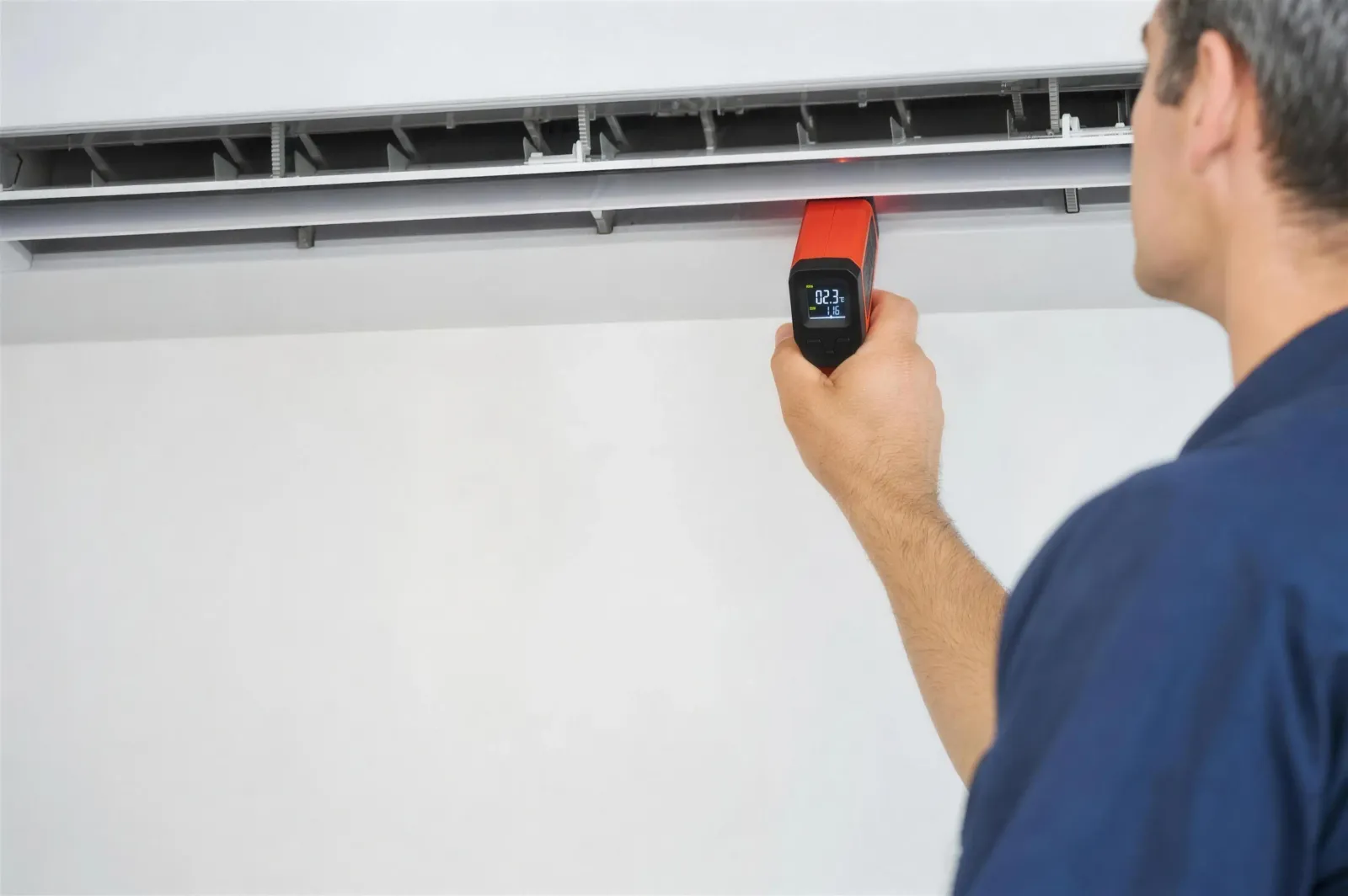
A standard home assessment typically takes about an hour, depending on the size of the home and what we are testing for. Our technician tests with an Air Advice device and reads what it measures: particulate matter, airborne chemicals (VOCs), formaldehyde, carbon monoxide, carbon dioxide, humidity and temperature.
The filter, the return and supply vents, the air handler and the ductwork all affect what you breathe, which is why the fixes we recommend after a test, such as filtration, ventilation or moisture control, can involve the system that moves your air.
Mold and fungal spore testing is part of a standard assessment, along with humidity analysis, because mold usually points to a moisture source that has to be found and fixed. Ask us about any room you are worried about, such as a bedroom that smells damp or a bathroom that never seems to dry.
What each reading tells you
Particulate matter is the dust you cannot see. PM10 covers particles up to 10 microns, such as pollen and the larger dust. PM2.5 covers the finer particles, 2.5 microns and smaller, which is the size range of wildfire smoke and the hardest part for a basic filter to catch. A high PM2.5 reading on a clear day points inside the house: the filter, a leaking return duct, cooking or a wood stove.
VOCs are gases given off by paint, cleaners, new furniture, flooring and building materials. A reading that is higher in one room than the rest often leads straight to the source, such as a recently finished room or a garage door that opens into the house. Ventilation and removing the source usually do more than any filter, because a particle filter does not catch gases.
Carbon dioxide is mostly a ventilation signal. People breathe it out, so it builds in a closed bedroom overnight or a full living room in winter, and a high number means the room is not getting enough fresh air. Humidity rounds it out. Too high, and mold and dust mites thrive; the spore count tells you whether that has already started. We show you each number next to where it was taken, so the reading and the room stay connected.
Smoke season and your home
Smoke is a Shasta County fact of life. In 2018 the Carr Fire and in 2020 the Zogg Fire both sent it through neighborhoods across the county. Per CAL FIRE, the Carr Fire covered 229,651 acres with 1,614 structures destroyed, while the Zogg Fire covered 56,338 acres with 204 destroyed.
Here is what the EPA advises for a smoky week. Use a filter rated MERV 13 or higher if your system can handle it, and have a technician confirm that first. Set the fan to on instead of auto, and close any fresh-air intake so the system recirculates the air already inside. Change a dirty filter promptly. The full list is in the EPA guide to indoor air filtration, and our wildfire smoke and HVAC filtration guide walks through each step.
For a room where you need cleaner air, the EPA and CARB point to a portable air cleaner sized for the room. Look for one certified by CARB, and match its smoke clean air delivery rate to the room: at least two-thirds of the floor area. CARB’s Smoke Ready California page explains how. After a smoky stretch, a test shows how much fine particulate your home is holding, so you can decide whether your filter and ducts are doing enough.
Reading the results and what comes next
We walk you through the results in plain language and recommend specific fixes: filtration, ventilation or moisture control, based on what we actually found. You do not get a stack of numbers and a sales pitch. You get what was measured, where it was measured and which fix matches it. If everything reads normal, that is a useful answer too, and you can stop wondering about it.
Often the answer is simple. A better filter, a cleaned coil or a duct repair can take care of it, and our maintenance visits keep filters and coils in shape between tests. When the problem is stale air or poor airflow, the fix may be sealing and balancing, which is the work of our insulation and ventilation service.
If the numbers point at the system itself, our HVAC repair service can look at it. And if equipment is old enough that replacing it makes more sense, we will say so and explain the options. For a sense of what that costs in California, our HVAC cost guide gives sourced price ranges. We do not publish a price for testing here, so call (530) 972-2739 and we will quote it for your home.
Testing homes around Redding
Apex is based in Redding, and testing visits reach nearby towns such as Anderson, Cottonwood and Red Bluff. Each town page carries its own local facts, and the service area page covers the rest.
Our office hours are 7am to 5pm. First responders receive a 15 percent discount; mention it when you call. To book a test, call (530) 972-2739 or send a request through the contact form.
Real Answers, Not Guesses
We go beyond a basic walkthrough with testing that shows exactly what’s in your air, then translate the results into a plan you can act on, from filtration to our insulation & ventilation service for sealing and balancing airflow.
Air Advice Testing Equipment
We test with an Air Advice device, the same class of pro-grade equipment used across the indoor air quality industry.
Chemicals & Particulate Matter
Readings cover airborne chemicals (VOCs), particulate matter, and formaldehyde levels.
CO & CO2
Carbon monoxide and carbon dioxide levels are measured to flag combustion and ventilation issues.
Humidity & Temperature
Humidity and temperature readings round out the picture of what’s actually happening in your air.
Air Quality Questions From Redding Households
Fine and coarse particulate matter (PM2.5 and PM10), volatile organic compounds, mold and fungal spores, humidity, carbon dioxide as a ventilation check, and the overall allergen load in the air. We test with an Air Advice device, and you see each reading for the place it was taken.
It can tell you how much fine particulate the air holds when we test, and PM2.5 is the size range of wildfire smoke. A high reading on a clear day after a smoky stretch suggests the filter, the ducts or the house itself is still holding it, and that points to the next step.
Spore testing and humidity readings can show that mold is likely somewhere, even when nothing is visible, and the room readings narrow down where. The real fix is the moisture behind it, such as a leaking duct, a damp crawl space or a bathroom without a working exhaust fan, so that is what we look for next.
For one room during smoke, it can help a lot. The EPA and CARB point to a CARB-certified unit with a smoke clean air delivery rate of at least two-thirds of the room’s floor area. It will not fix a moisture problem, a leaking duct or a high VOC source, which is why testing first saves money.
We recommend a fix only when a reading calls for one, and we tell you which reading. Often the answer is a better filter, a cleaned coil, a duct repair or an exhaust fan. If the numbers come back normal, we say so, and you have spent the money on peace of mind rather than equipment.
Usually, yes. Duct cleaning removes dust and debris, but it does nothing for humidity, VOCs or a leaking return pulling attic air. A test shows whether particulate is the problem at all, and if it is, whether the ducts or something else is the source.
It can if the system is not built for it. A denser filter such as MERV 13 catches more fine particles but also restricts airflow, and the EPA advises using one only if your system can handle it. We check your blower and filter rack before recommending a grade.
Yes. Indoor air quality is part of our commercial work as well as our home service, from offices to shops. The same readings apply, and in a workspace carbon dioxide is often the first number to watch, because full rooms with closed doors run short on fresh air.
Other services
- New HVAC Installations
- HVAC Repairs
- AC Repair
- Furnace Repair
- Emergency HVAC Repair
- HVAC Maintenance Plans
- Commercial HVAC Services
- Mini Split Installation
- Heat Pump Installation
- Insulation & Ventilation
- Duct Repair & Replacement
- Swamp Cooler Service
- Blown-In Insulation
- Whole House Fans
- Mini Split Repair & Service
- Thermostat Installation
- Thermostat Repair
- Home Sale HVAC Inspection
Our Commitment
Transparent Pricing
Clear, upfront estimates before we start: no hidden fees, no surprise charges once the work is underway.
Guaranteed Work
Trusted parts and materials on every job, backed by our labor guarantee.
Emergencies don’t just happen during business hours. We’re available 24/7.